

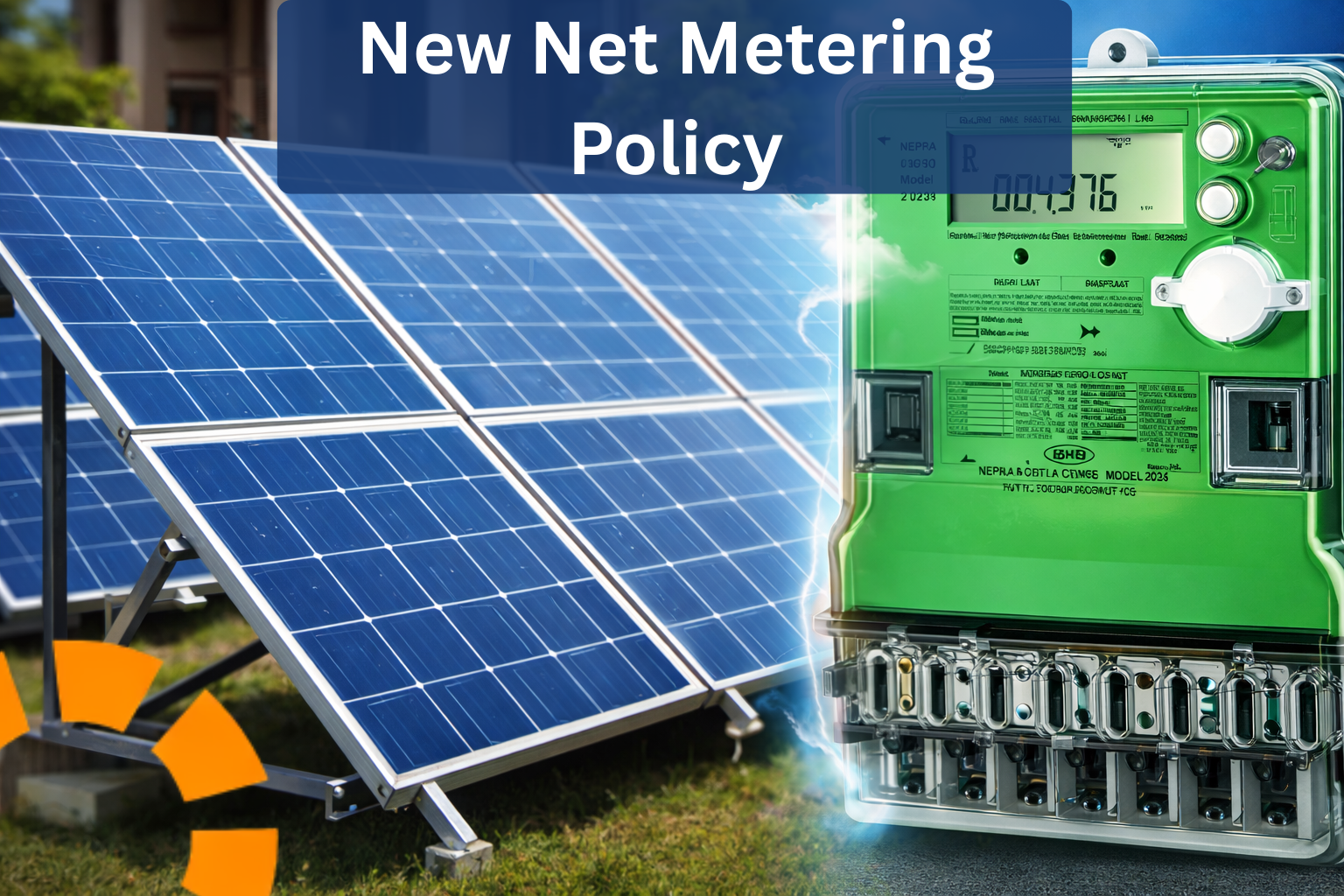
New Net Metering Policy
What Is Net Metering in Pakistan?
Pakistan’s solar industry has grown rapidly over the past few years, with thousands of residential and commercial consumers shifting to rooftop solar. With this surge in installations, the regulatory framework has also evolved. Recently, the National Electric Power Regulatory Authority (NEPRA) introduced updates to the Net Metering Policy in Pakistan, aiming to balance grid stability, financial sustainability of DISCOs, and continued solar adoption.
In this blog, we’ll break down the new net metering policy, how it affects homeowners and businesses, and what you should consider before installing a solar system in 2026.
Net metering is a billing mechanism that allows solar system owners to export excess electricity back to the national grid and receive credits on their electricity bills.
Under the framework regulated by NEPRA:
Consumers install a bi-directional (net) meter
Excess solar energy is exported to the grid
Units exported are adjusted against imported units
The consumer pays only for the net difference
This policy has made solar investment highly attractive across Pakistan.
Key Highlights of the New NEPRA Net Metering Policy (2025)
On 21 December 2025, the Ministry of Energy approved a revised solar framework after discussions with the National Electric Power Regulatory Authority (NEPRA), DISCOs, and other stakeholders.
Under the new decision:
The old Net Metering system has been replaced with a Net Billing system
Exported solar units will now be paid at a fixed rate
Agreement duration has been reduced
Licensing requirements have changed
The government stated that the goal is to:
Improve grid stability
Reduce financial pressure on the power sector
Adjust incentives according to current market conditions
Simple Comparison Table
| Feature | Old Net Metering | New Net Billing |
|---|---|---|
| Payment per exported unit | Rs 25.98 per unit | Rs 11.13 per unit |
| Adjustment system | Units adjusted in bill | Units bought at fixed rate |
| Agreement duration | 7 years | 5 years |
| NEPRA licence | Not required (up to 25 kW) | Required (up to 25 kW) |
| Policy type | Unit adjustment | Cash-based billing |
Under the revised policy:
Solar users will now receive Rs 11.13 per unit for exported electricity.
Previously, users were getting around Rs 25.98 per unit.
The government explained that the old rate was putting financial pressure on the power sector and was not sustainable long-term.
What About Electricity You Take From the Grid?
There is no change in how you pay for grid electricity.
You will still:
Pay according to NEPRA-approved tariffs
Be charged peak and off-peak rates
Receive your monthly bill in the same structure
So even under the new system, solar users still pay much less than non-solar consumers — especially when they maximize self-consumption.
Agreement Duration Reduced to 5 Years
Another major change:
Solar agreements are now valid for 5 years instead of 7 years
This means:
After 5 years, the agreement can be revised
Tariff rates may change
Users may need to renew their agreement
This gives regulators flexibility to adjust policies in the future.
Will This Policy Affect Existing Solar Users?
Existing users may not face an immediate major impact, but:
Winter bills may increase for some users
Businesses exporting large units may see lower returns
Oversized systems designed only for export will be less profitable
However:
Self-consumed solar energy still gives maximum savings
Electricity prices from the grid are still high
Solar remains cheaper long-term
Is Solar Still a Good Investment in Pakistan?
Yes ✅
Even with the new policy, solar energy remains one of the smartest investments in Pakistan.
Key Benefits:
✔ Protection against rising electricity prices
✔ Reduced dependency on DISCOs
✔ Clean, renewable energy
✔ 20–25 year system life
✔ Increased property value
The key strategy now is:
👉 Focus on self-consumption, not export profit.
At SiSUN ELECTRIC, we design systems that maximize daytime usage so our clients get the best ROI under the new net billing framework.
